How to Start a Prop Firm in 2026: Stack, Costs and the CRM That Holds It Together
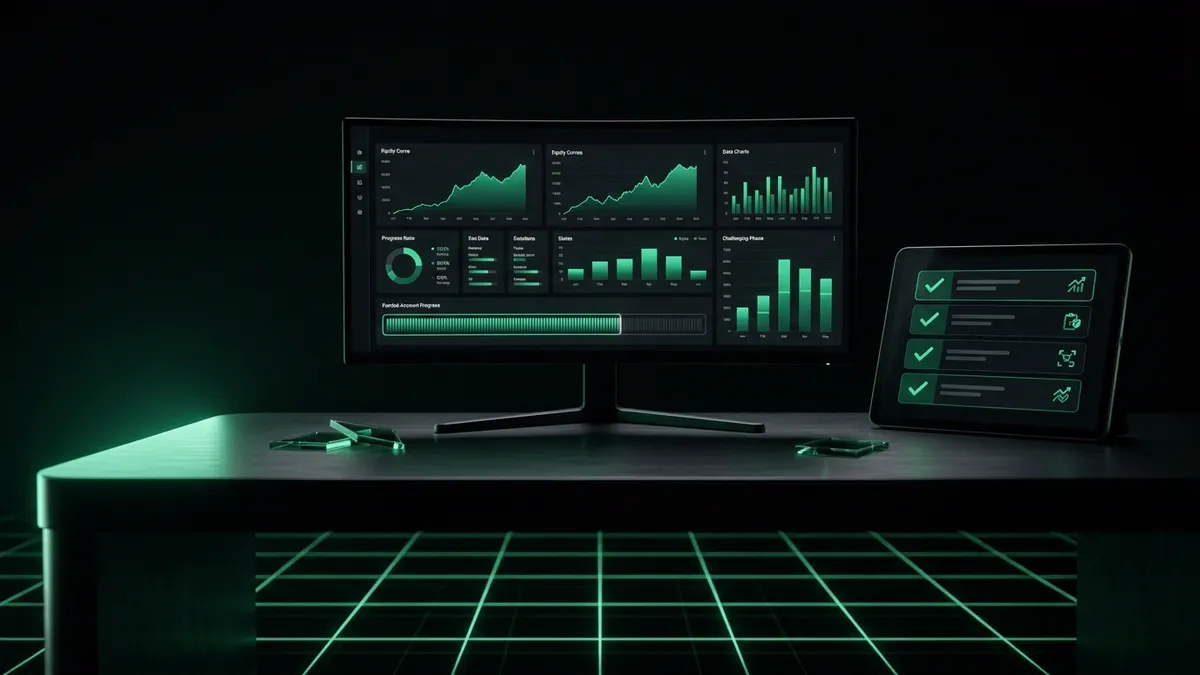
Every week someone asks us the same question, usually after a few months of watching funded-trader firms grow on social media: how do you actually start a prop firm? The honest answer is that the trading platform is the easy part. What decides whether a firm survives its first wave of payouts is the operation behind it: how challenges are sold, how accounts are provisioned, how rules are enforced, how affiliates get paid and how support keeps up. This is the stack we build for prop firms, so here is the version of the answer we give on calls.
What a prop firm really is
Strip away the marketing and a modern retail prop firm is a subscription business with a risk engine attached. Traders buy an evaluation (a challenge), trade a simulated or funded account under a set of rules (daily drawdown, maximum loss, profit target, minimum trading days), and the firm pays a share of the profits to the ones who pass. Revenue comes from challenge fees and resets; the largest cost is payouts to traders who beat the rules, followed by platform, data and payment-processing fees.
That means three systems have to agree with each other at all times: the trading platform where the account lives, the risk engine that watches every account against its rules, and the CRM that knows who bought what, who referred them, what phase they are in and what they are owed. When those three drift apart, you get the failure modes prop firms are known for: disputed breaches, delayed payouts, affiliates chasing commissions and a support inbox nobody can clear.
The stack, in order
1. Trading platform and liquidity
Most firms launching in 2026 white-label one of three platforms: MetaTrader 5 for the largest installed base, cTrader for a more polished experience, or Match-Trader for a flexible API. Which one you pick matters less than whether your CRM can create, fund, breach and close accounts on it automatically. If a human has to log in to the platform admin to provision an account, you do not have a firm, you have a queue.
2. The CRM and client portal
This is the piece traders see and the piece most founders underestimate. The portal has to sell the challenge, take payment, create the account, show live metrics against the rules, move the trader from phase one to phase two to funded, and run the payout request flow. Our white-label CRM for prop firms was built for exactly this: challenge products with phases and rules, automatic account provisioning through the platform bridge, live dashboards with drawdown and target tracking, a payout workflow with approvals, and an affiliate module with tiers, links and commission statements.
3. Risk engine
Rules have to be enforced by software, in real time, from the same data the trader sees. A breach that the trader discovers in an email two days later is a chargeback waiting to happen. The engine should log every rule evaluation so that support can answer "why was I breached" with a timestamped record instead of an opinion.
4. Payments and payouts
Card processors are cautious with prop firms, so plan for at least two processors plus crypto rails from day one, and design the payout flow with KYC, cool-down periods and approval steps built in. This is also where the CRM earns its keep: every payout request should carry the account history, the rule log and the KYC state on one screen.
5. Affiliates and KOLs
Prop firms grow through creators. Educators, signal groups and YouTube traders bring the challenge buyers, and they expect real-time stats, reliable tracking and on-time commission payments. After more than twelve years working directly with KOLs and educators, our view is simple: the affiliate dashboard is a product, not a report. Treat it like one and your partners stay.
6. Support and operations
Ticketing, a knowledge base, canned answers for the twenty questions that make up most of the volume, and an internal view of each trader that shows everything in one place. When the CRM is the system of record, support stops being detective work.
What it costs
Budgets vary wildly with how much you build versus rent. Published 2026 operator guides such as Track360's prop firm playbook place a lean launch somewhere between 8,000 and 15,000 dollars, and a launch built to survive the first payouts and chargebacks between 30,000 and 70,000 dollars, before trader payouts. White-label platform licences and data feeds are recurring, so model them monthly rather than as a setup line.
The trade-off we see most often: renting an all-in-one prop firm platform is fastest, but it locks your data, your branding and your roadmap into someone else's product. Owning the CRM and portal on top of a licensed trading platform costs more up front and gives you the two things that matter when you scale, control of the client relationship and the freedom to change the rules of your own business. We lay out that decision in more detail in custom software versus SaaS.
Legal and compliance, briefly
Where you incorporate, how you describe the product (simulated versus live capital), which countries you exclude and how you handle KYC are decisions for a lawyer who has done this before, not for a template. What we can say from the software side is that every one of those decisions ends up as a rule in the CRM: country blocks at checkout, disclaimers on the challenge page, KYC gates before the first payout, and audit logs for everything. Build the system so those rules are configuration, not code changes.
A launch sequence that works
- Pick the trading platform and secure the licence, data feed and demo environment.
- Define challenge products: phases, rules, pricing, resets and the payout split.
- Stand up the CRM and portal with automatic provisioning against the platform bridge.
- Connect two payment processors and one crypto rail, then test refunds and chargebacks on purpose.
- Onboard five to ten founding affiliates with their own dashboards before public launch.
- Run a closed beta with real challenge buyers for two weeks and fix the support flow.
- Launch publicly with a support playbook, not just a landing page.
Frequently asked questions
Can I start with a white-label platform and move to my own later?
Yes, and many firms do. The migration is painful only if your trader and affiliate data are trapped. Ask any vendor for a full data export before you sign.
How long does a build take?
On our CRM, a branded portal with challenge products, provisioning, dashboards, payouts and affiliates is a matter of weeks, because the core already exists and the work is configuration, branding and the platform bridge for your provider.
Do I need a risk engine on day one?
You need rule enforcement on day one. Whether it is a separate service or a module of the CRM depends on volume, but it has to be automatic and logged from the first challenge you sell.
If you are planning a firm and want to see the portal, the affiliate module and the payout flow working, book a discovery call. We will walk you through a live deployment and tell you honestly what to rent and what to own.